MADRS.net's AI Report: Clinical Insights for Depression
A score on the Montgomery-Åsberg Depression Rating Scale (MADRS) provides a vital snapshot of depressive symptom severity. For decades, clinicians have trusted this number to gauge baselines and track treatment progress. But what if you could look beyond that single number? What if you could transform that score into a detailed, personalized map of your mental health?
This is where technology meets clinical expertise. At MADRS.net, we’ve developed a unique AI-powered analysis that goes deeper than a traditional score. It provides a comprehensive report filled with clinical insights, pattern recognition, and actionable recommendations. Let’s explore how clinical expertise and AI work together to decode your symptoms.
The journey to deeper understanding begins with a simple, foundational step. You can start your MADRS assessment on our platform to get your initial results. From there, you have the option to unlock a new level of insight with our AI analysis.

MADRS AI Report Accuracy: Deconstructing Our Algorithm
Trust is paramount, especially in mental health. We believe that trust is built on transparency. To understand the value of our AI report, it’s important to understand how it works. Our algorithm prioritizes transparency. Built on clinical data and machine learning, it delivers reliable insights—never hiding behind a 'black box' approach.
What Data Fuels Our AI for Personalized Analysis?
Your analysis begins with your answers to the 10 standard questions on the depression scale. These clinically validated responses form the foundation of your personalized report. To further enhance the report’s personalization, you can choose to provide additional, optional context about your situation. Our AI doesn't just add up the points—it analyzes the relationships between your responses.
This process allows the system to identify subtle patterns and symptom clusters. For instance, it can recognize how reported sleep disturbances might correlate with changes in appetite or concentration. This multi-dimensional view is what elevates the analysis from a simple score to a rich, personal narrative.

The Science Behind the Score: Clinical Validation & Methodology
Our AI report is not a replacement for the rating scale; it is an enhancement of it. The methodology is grounded in decades of psychiatric research and clinical practice. We have trained our machine learning models on vast, anonymized datasets that connect specific patterns of responses to documented clinical outcomes and observations.
This means our AI has learned to recognize symptom combinations that are clinically significant. The insights it provides are designed to mirror the analytical process a trained professional might use, but with the power of large-scale data analysis. It respects the integrity of the original scale while adding a new layer of interpretive depth.
Ensuring Precision: How Machine Learning Enhances Interpretation
Machine learning is a type of artificial intelligence that excels at finding meaningful patterns in complex data. In simple terms, we've taught our system to read between the lines of a clinical assessment. A traditional score tells you the severity of symptoms, but our AI helps explain the character of those symptoms.
This technology allows for a much more nuanced interpretation. Instead of just knowing your score is in the "moderate" range, the AI can highlight that your score is primarily driven by cognitive symptoms like difficulty concentrating, or somatic symptoms like fatigue. This precision is key to developing a more targeted and effective approach to mental wellness.
Clinical AI Depression Insights: Monitoring Symptoms & Treatment Efficacy
Our AI report provides you with clinical-grade insights that are easy to understand and practical to use. It translates complex data into a clear, structured analysis that empowers both individuals and their healthcare providers.
Interpreting Your Personalized Mental Health Analysis
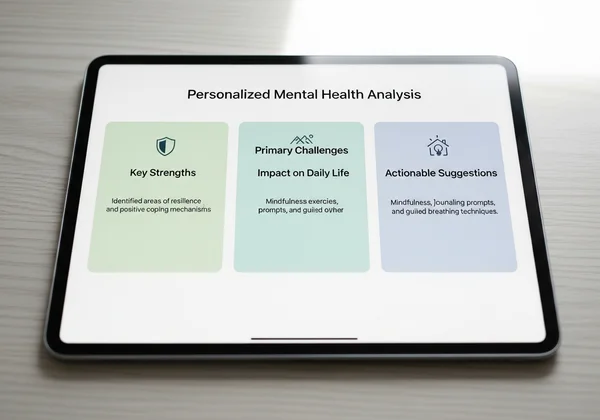
When you unlock your AI report, you receive more than just data. You get a comprehensive breakdown that includes:
- Key Strengths: Highlighting areas of resilience and positive functioning.
- Primary Challenges: Pinpointing the most significant symptom clusters affecting you.
- Impact on Daily Life: Explaining how these symptom patterns may manifest in your work, relationships, and personal care.
- Actionable Suggestions: Offering evidence-based, non-prescriptive strategies to discuss with your healthcare provider.
This structured format makes the information digestible and directly applicable to your life, fostering a more informed and proactive conversation about your mental health.
Symptom Cluster Identification Strategies
One of the most powerful features of the AI analysis is its ability to identify symptom clusters. Depression is rarely a single issue; it is often a web of interconnected symptoms. The report might show a strong link between "inner tension" and "reduced sleep," providing a clearer target for intervention. Use our AI-powered depression assessment tool regularly to track these clusters. This creates a detailed progress timeline, showing how your well-being evolves.
Longitudinal Progress Tracking with AI
For clinicians and their patients, this level of detail is a game-changer for monitoring treatment efficacy. A static overall score might not change for weeks, which can be discouraging. However, the AI report could reveal that while the total score is stable, the severity of specific symptoms—like pessimistic thoughts—is decreasing. This granular feedback provides early indicators that a treatment plan is starting to work. It allows for more precise adjustments and helps maintain motivation throughout the recovery process. The AI acts as a sensitive instrument, detecting subtle shifts that a simple score might miss. Track your symptom progression over time with our secure dashboard.
Why Our Personalized Mental Health Analysis Stands Out
While many tools can give you a clinical depression score, our platform is unique in its ability to provide a deep, personalized mental health analysis. This distinction is crucial for anyone serious about understanding and managing depressive symptoms effectively.
The Difference: Basic Score vs. AI-Powered Deep Dive
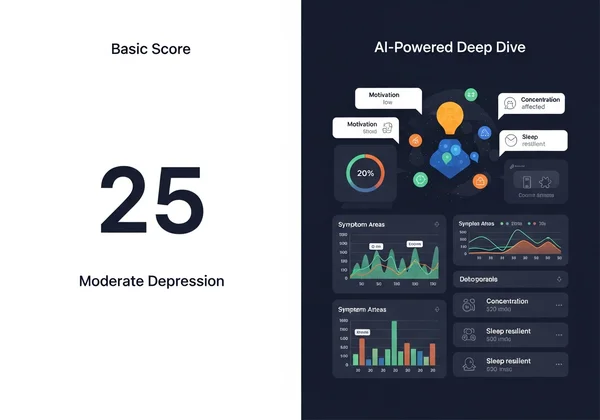
Think of a basic clinical score as a single data point—a headline. It tells you what your level of symptom severity is. It’s essential, but it’s only the beginning of the story. Our AI-powered deep dive provides the full story. It explains the why and the how behind the score.
- Basic Score: A number indicating severity (e.g., 25 - Moderate Depression).
- AI Report: A narrative explaining that your score is driven by significant challenges with motivation and concentration, but supported by resilient sleep patterns, with suggestions for structuring daily tasks.
This contextual analysis transforms a number into a powerful tool for self-awareness and clinical dialogue. This detailed approach offers a different perspective than other common screeners. Learn more about MADRS vs. PHQ-9 comparisons.
Actionable Recommendations: From Data to Daily Life Strategies
Knowledge is powerful, but actionable knowledge is transformative. Our AI report is designed to bridge the gap between data and daily life. The recommendations are not generic advice; they are tailored based on your specific symptom profile.
For example, if your report identifies a strong connection between anxiety and social withdrawal, the recommendations might focus on strategies for graded exposure or communication techniques. These suggestions are designed to be practical starting points for discussion with a therapist or doctor, ensuring your next steps are both informed and personalized.
Trust and Transparency: Our Commitment to Ethical AI in Mental Health
We are acutely aware of the responsibility that comes with applying AI to mental health. Our commitment to you is built on two pillars: trust and transparency. We adhere to strict privacy protocols to ensure your data is always secure and confidential.
Furthermore, we are transparent about the role of our tool. It is a powerful support system, but it is not a substitute for a human clinician. Our ethical framework ensures that our AI is developed and deployed responsibly, always with the goal of supporting, not replacing, the essential relationship between a patient and their healthcare provider.
Unlocking Deeper Understanding with Your AI Report
Your assessment result is the starting line—not the finish. With AI-driven insights, you gain a clear, comprehensive, and actionable analysis of your symptoms. By deconstructing your results into identifiable patterns, challenges, and strengths, our AI empowers you to have more informed conversations with your healthcare provider and take a more proactive role in your wellness journey. It transforms a standard clinical assessment into a personalized guide.
Ready to see beyond the score? The first step is simple and free. Calculate your MADRS depression score today and discover the option to unlock a new level of understanding with your personalized AI report.
Frequently Asked Questions About Our AI Analysis
What makes your AI depression analysis unique?
Our analysis is unique because it combines the "gold standard" clinical scale with a sophisticated AI engine. While other tools provide a score, we deliver a deep, personalized report that identifies specific symptom clusters, explains their potential impact on your daily life, and offers tailored, actionable recommendations. This transforms a static number into a dynamic tool for insight.
How accurate is the personalized analysis report for mental health insights?
The accuracy of our AI report lies in its evidence-based foundation. The algorithm is trained on extensive, anonymized clinical data, allowing it to recognize patterns that are well-established in psychiatric research. While it is not a diagnostic tool, it provides a highly accurate and structured reflection of your self-reported symptoms, designed to facilitate meaningful conversations with a healthcare professional.
Can the AI report replace a professional medical diagnosis?
Absolutely not. It is critical to understand that our personalized depression analysis report is an informational and supportive tool, not a medical diagnosis. It is designed to provide valuable insights and enhance your understanding of your symptoms. You must always consult a qualified healthcare professional, such as a doctor or therapist, for any diagnosis or treatment decisions. We encourage you to take our confidential assessment and share the report with your provider.
How do you ensure the privacy and security of my AI report data?
We prioritize your privacy and security above all else. All data submitted is handled with strict confidentiality. We use robust encryption to protect your information during transmission and storage. Our systems are designed to comply with global privacy standards, and we never share your identifiable personal data without your explicit consent. Your trust is our most important asset.