MADRS as a Clinical Endpoint: How It Measures Change
Updated: October 9, 2026
The Montgomery–Åsberg Depression Rating Scale (MADRS) measures selected depressive symptoms. A MADRS clinical endpoint is a specific outcome defined in a study protocol, such as change in total score from baseline to week four. The scale supplies the measurement; the protocol specifies the outcome and timing, while the study design and analysis determine how to interpret the result.
This guide explains the ten MADRS items, clinician ratings, self-report formats, and the difference between improvement and remission. You'll find a worked scoring example, a simple treatment-group comparison, and a checklist for reading findings carefully.
You can explore the 10-item MADRS assessment as an educational reference, not a clinical evaluation.

Illustrative scene; the displayed charts and forms are not clinical records or scoring instructions.
How Do MADRS Scores Become a Clinical Trial Endpoint?
MADRS is a ten-item, clinician-rated measure of depressive symptom severity designed to detect change over time. Researchers may use scores from the scale to evaluate a clinical trial outcome.
The scale is the measurement instrument; an endpoint is the specific outcome and time frame defined in the research protocol.
What Is a Prespecified Clinical Trial Endpoint?
A trial might define its primary endpoint as the change in MADRS total score from baseline to week four. That specifies:
- Measurement: MADRS total score.
- Starting point: Baseline assessment.
- Time frame: The week-four assessment.
A primary endpoint addresses the study's main question; secondary endpoints examine additional planned outcomes. ClinicalTrials.gov explains why outcome measures, metrics, and time frames must be specified.
The protocol also determines how researchers compare participants or groups. A change in one person's score cannot, by itself, show that a treatment caused it.
Why Researchers Use MADRS to Track Symptom Change
Montgomery and Åsberg's 1979 paper describes the development of a scale intended to be sensitive to treatment-related symptom change.
MADRS focuses on selected symptoms that clinicians can rate repeatedly. Studies may examine average score changes, the proportion meeting a response criterion, or remission rates. Each is a different outcome and must be interpreted according to the protocol.
What Do the 10 MADRS Items and Total Score Measure?
MADRS captures selected emotional, cognitive, and physical symptoms. It does not measure every aspect of a person's mental health or functioning.
What the 10 MADRS Items Assess
The original MADRS includes:
- Apparent sadness
- Reported sadness
- Inner tension
- Reduced sleep
- Reduced appetite
- Concentration difficulties
- Lassitude, or difficulty initiating activities
- Inability to feel pleasure or emotional engagement
- Pessimistic thoughts
- Suicidal thoughts
For example, sleep may change without an equally large change in concentration. Individual items therefore matter alongside the total score.
How Item Ratings Add Up to a 0–60 Score
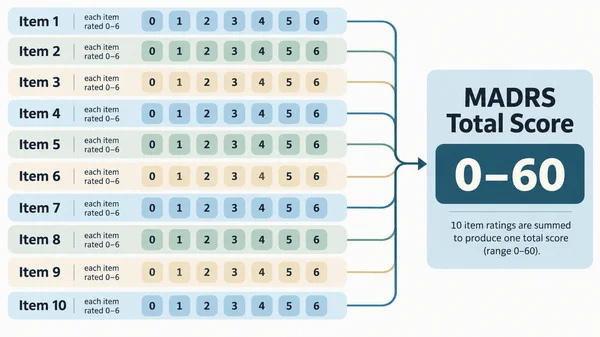
A trained clinician rates each item from 0 to 6. Adding the ratings gives a total from 0 to 60; higher scores generally reflect greater measured symptom severity. The items and total range are described in the MADRS assessment methods of published clinical research.
A total cannot reveal which symptoms contributed most. Two people can have the same score but different item-level profiles.
How Is MADRS Administered? Clinician Ratings and Self-Report
Not every questionnaire labeled MADRS uses the same administration or scoring method. This distinction matters when comparing online results with clinical studies.
How Clinicians Administer the Original MADRS
The original MADRS is clinician-rated. A trained professional conducts an assessment, considers reported symptoms and relevant observations, and assigns ratings using the instrument's guidelines.
Research studies may use standardized interviews, rater training, and established remote-assessment procedures to improve consistency.
MADRS-S and Online Assessments: Important Differences
MADRS-S is a separate nine-item self-report scale, not the original ten-item instrument completed independently. Its item content and scoring methods differ, as discussed in a published psychometric study of MADRS-S.
| Assessment format | Who provides ratings? | Key distinction |
|---|---|---|
| Original MADRS | Trained clinician | Ten clinician-rated items |
| MADRS-S | Questionnaire respondent | Separate nine-item self-report instrument |
| Online MADRS questionnaire | Digital questionnaire respondent | Equivalence depends on the implementation and supporting validation |
MADRS.net describes its tool as ten online questions with immediate scoring. That feature description does not establish clinical validation. An online score must not automatically be treated as equivalent to a trained clinician's rating or a validated trial endpoint.
Key takeaway: Identify the instrument version and administration method before comparing results.
How Do Studies Interpret MADRS Change, Response, and Remission?
Trials typically assess change relative to a starting point. Interpreting that change requires attention to both individual scores and comparisons across study groups.
Baseline, Absolute Change, and Percentage Reduction
Baseline is the starting measurement. Absolute change is the follow-up score minus baseline; percentage reduction is the decrease divided by baseline, multiplied by 100.
Consider this fictional example:
| Measurement | Example value |
|---|---|
| Baseline MADRS score | 32 |
| Follow-up MADRS score | 16 |
| Absolute change | −16 points |
| Percentage reduction | 50% |
This is a 16-point decrease, or 50% reduction. It documents a change in measured symptoms, not proof of recovery or treatment effectiveness.
Response vs Remission: Study-Specific Definitions
A study may define response using a percentage reduction from baseline and remission using a low absolute score. Check the actual protocol rather than assuming that one definition applies to every study.
For example, a 2025 randomized clinical trial defined MADRS response as a reduction of at least 50% and remission as a total score of 10 or less, summarizing rates at each visit. Other protocols may use different definitions. The fictional 32-to-16 example meets the response criterion but not that remission threshold.
Why Between-Group Differences Matter
Suppose a fictional study reports a mean MADRS change of −12 in Group A and −8 in Group B. The difference in average change is −4 points, not −12. Both groups improved; the question is whether the difference between them is credible and meaningful.
Researchers assess uncertainty, such as confidence intervals, along with the prespecified statistical analysis. For a fictional difference of −4 points, an interval from −6 to −2 excludes zero; an interval from −7 to +1 includes zero and is compatible with no difference in that analysis. The latter does not prove that the treatments are equivalent. These intervals are teaching examples, not calculated study results.
Even a statistically significant difference may not imply a change that matters in everyday life. The fictional numbers cannot establish a real treatment benefit. In a real trial, the reported estimate may be adjusted for baseline scores and other prespecified factors rather than simply subtracting raw averages.
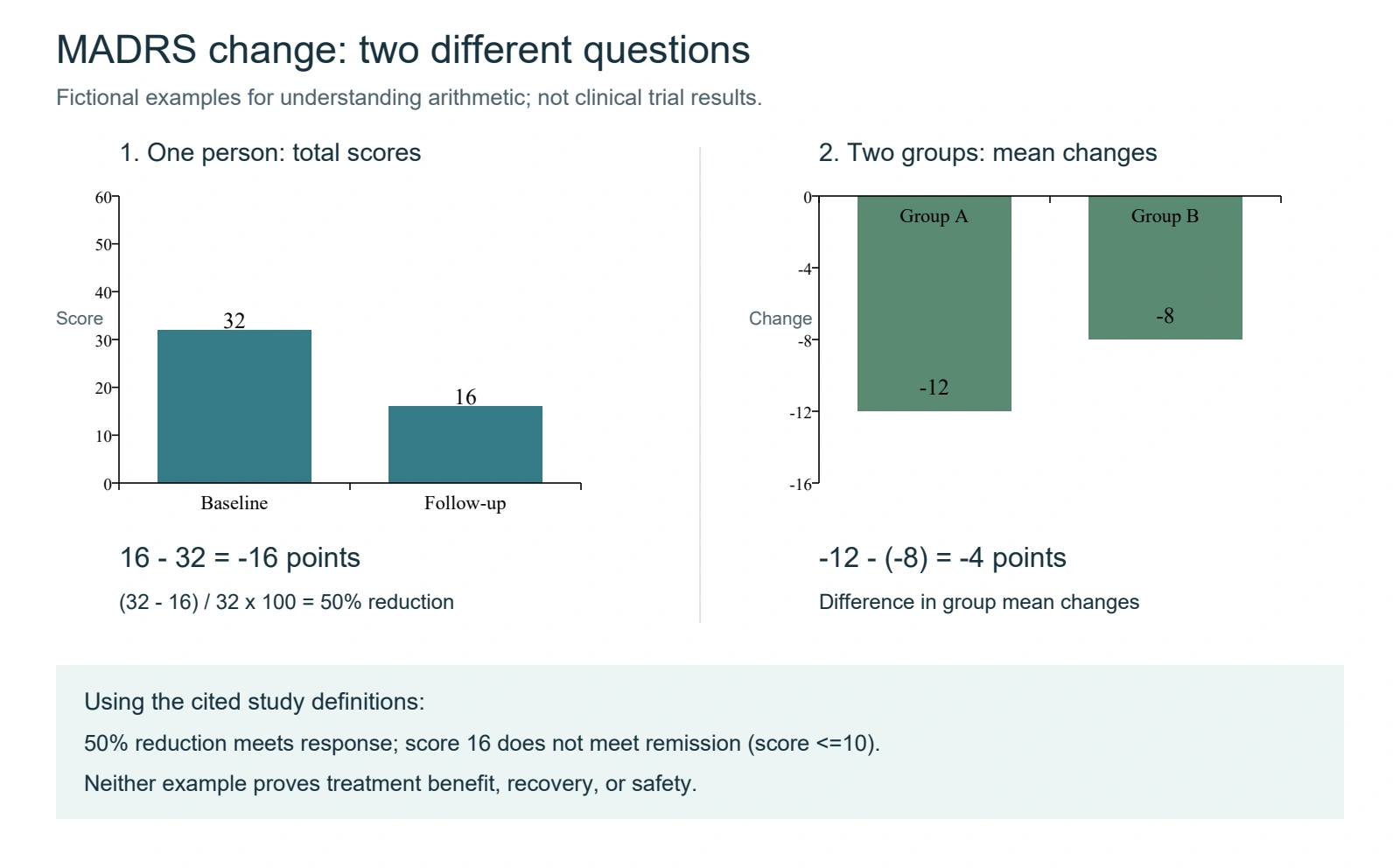
Fictional arithmetic examples. A 50% reduction meets the cited response definition; a follow-up score of 16 does not meet its remission threshold of 10 or less.
A Checklist for Reading a MADRS Trial Result
Before interpreting a headline, check:
- Endpoint and visit: Is the result the planned primary endpoint, a secondary endpoint, or an exploratory analysis? Which visit does it describe?
- Instrument and raters: Which MADRS version was used, how was it administered, and were raters trained and blinded to treatment assignment?
- Comparator: Is the claim based on a difference against placebo or another treatment, or only on change within one group?
- Estimate and uncertainty: What are the between-group difference and confidence interval? Is the estimate adjusted or unadjusted?
- Missing data: How many participants had follow-up ratings, why did others leave, and what assumptions were used to analyze missing outcomes?
- Meaning and duration: How were response and remission defined, and was improvement maintained? Are functioning and safety reported separately?
The methods of the cited randomized trial provide an example of reporting raters, endpoint timing, analysis populations, and a repeated-measures model. A single score or percentage cannot answer all these questions.
How Can You Explore MADRS Scores Without Overinterpreting Them?
A few practical questions can help you interpret an assessment responsibly.
Before drawing conclusions, check:
- Assessment method: Clinician interview, validated self-report scale, or online questionnaire?
- Comparison: One assessment or repeated measurements under reasonably consistent conditions?
- Wider context: Changes in daily functioning, stress, sleep, physical health, or circumstances?
A lower score can reflect improvement in measured symptoms while substantial challenges in daily life remain.
For a clinical conversation, use the appointment-preparation checklist in the guide to discussing MADRS results with a doctor. Bring your symptom history, daily-life concerns, and the assessment method; an online total is not a clinical diagnosis.
What Does Research Show About MADRS Symptom Changes and Ratings?
Published research illustrates why total scores, item patterns, and assessment methods all deserve attention.
Why MADRS Item Patterns Can Differ
In a 2022 analysis by Borentain and colleagues, researchers examined data from two randomized trials of adults with treatment-resistant depression. A post hoc factor analysis identified three symptom groups:
- Affective and anhedonic: Apparent sadness, reported sadness, lassitude, and inability to feel.
- Anxiety and vegetative: Inner tension, reduced sleep, reduced appetite, and concentration difficulties.
- Hopelessness: Pessimistic and suicidal thoughts.
Changes in these groups were examined during esketamine trials. Within-group improvement did not mean that every factor showed a statistically significant advantage over the comparator at every visit. The analysis was exploratory, did not adjust for multiple comparisons, and was funded by Janssen. Its factors should not be assumed to be universal subscales across populations.
What Remote Ratings Reveal About Measurement Limits
Capodilupo and colleagues (2024) analyzed remotely collected MADRS item trends from 733 participants across two phase 3 study protocols for treatment-resistant depression and surveyed 75 raters.
Reduced sleep had one of the highest rates of between-visit score change, while raters considered reported sadness particularly useful for evaluating change. Observed item movement and perceived usefulness did not align perfectly. The study compared these rankings; it did not establish a universal hierarchy of symptoms or prove treatment efficacy.
This does not mean remote ratings are inherently unreliable. It shows why measurement procedures, trained raters, and study context matter.
MADRS vs HAM-D vs PHQ-9: Which Differences Matter?
MADRS, the Hamilton Depression Rating Scale (HAM-D), and the Patient Health Questionnaire-9 (PHQ-9) all address depressive symptoms, but their formats and scoring differ.
| Feature | MADRS | HAM-D | PHQ-9 |
|---|---|---|---|
| Common format | Clinician-rated | Clinician-rated | Self-report |
| Typical version | 10 items | 17 items | 9 items |
| Main use | Severity and change measurement | Severity and treatment outcomes | Symptom screening and monitoring |
| Key consideration | Rating consistency | Different symptom coverage and scoring | Depends on respondent reports |
Clinician-Rated MADRS and HAM-D
Both instruments have established roles in research, but they assess and weight symptoms differently. The NIDA description of HAM-D explains its interview-based ratings and 17 variables. A MADRS total therefore cannot be directly substituted for a HAM-D total.
MADRS and the PHQ-9 Self-Report Format
The PHQ-9 uses nine self-reported items, as described in its original validation study. Original MADRS ratings depend on a trained clinician. Neither format is inherently interchangeable with the other.
Practical takeaway: Use each instrument's own scoring and interpretation framework, not a numerical comparison of raw totals.
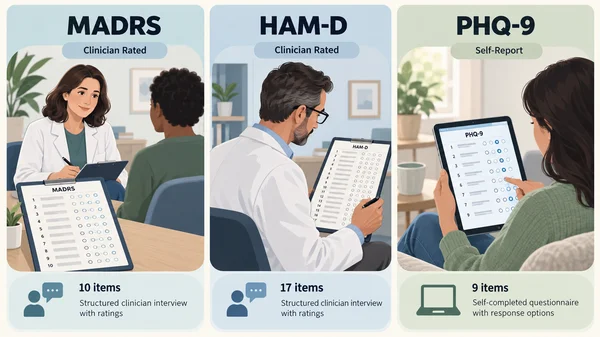
The illustrated forms are schematic, not validated questionnaires. Actual administration depends on the instrument and study procedures.
What Are the Limits of MADRS as a Clinical Endpoint?
A standardized symptom score can support research, but it cannot represent every aspect of mental health or everyday life.
Why Total Scores Need Clinical and Functional Context
MADRS does not fully assess work, relationships, physical health, or overall functioning. The same total can conceal different symptoms, and a decrease does not mean every important concern has resolved.
How Rater, Setting, and Timing Affect Interpretation
Key considerations include:
- Method: Clinician-rated and self-report scores are not automatically equivalent.
- Timing: Symptoms and circumstances may differ between visits.
- Rater: Training and interview procedures affect consistency.
- Population: Results from one research population may not generalize to another.
Avoid three common mistakes: using a severity label as a diagnosis, treating every score reduction as proof of treatment success, and comparing totals across different instruments without checking how they were obtained.
If symptoms persist, worsen, or interfere with daily life, consider consulting a qualified healthcare professional. This article and the linked online questionnaire are for information and self-understanding, not diagnosis, treatment decisions, or independent measurement of treatment efficacy.
MADRS includes an item about suicidal thoughts. Safety concerns matter regardless of the total score. If you feel at immediate risk of harming yourself, seek emergency help or contact a crisis service in your location.
Reading MADRS Changes in Context
MADRS helps researchers quantify selected depressive symptoms. A prespecified clinical endpoint gives those scores a particular role in a study; the research design and treatment-group comparison determine how the outcome can be interpreted.
Keep the distinctions clear: baseline is a starting point, change is a measured difference, response and remission use separate criteria, and a change within one person is not the same as a demonstrated difference between treatment groups.
For further reading, browse the MADRS educational resource collection. Bring questions about symptoms or treatment to a qualified professional.
Frequently Asked Questions
Is a MADRS Score of 40 Considered Severe?
Under one published classification, a MADRS score of 35 or higher is in the severe symptom range, so 40 fits that category. The study proposing that cutoff was preliminary and involved a small sample. Other approaches use different boundaries; no cutoff alone provides a diagnosis.
Can MADRS Be Completed Without a Clinician?
The original ten-item MADRS is clinician-rated. MADRS-S is a distinct nine-item self-report scale, and digital questionnaires may also be completed independently. Their totals should not automatically be treated as equivalent to clinician ratings.
Does a 50% MADRS Score Reduction Mean Remission?
No. A reduction of at least 50% satisfies the response criterion in the trial cited above. Remission depends on an absolute score threshold and timing specified by the study. A reduction from 40 to 20 would count as response under that definition but not remission if the threshold is 10 or lower.
Can an Online MADRS Score Be Used as a Clinical Trial Endpoint?
Not automatically. Researchers must use an appropriate instrument and administration method under a predefined protocol, with evidence supporting its measurement properties for that use. A numerical score from an online tool alone does not establish clinical-trial suitability.
Why Can Two People Have the Same MADRS Total Score but Different Symptoms?
Ten item ratings are added together. Someone with higher sleep and appetite ratings can have the same total as someone with greater sadness and concentration difficulties. Item-level details provide context that the total does not.
How Often Is MADRS Measured in Clinical Trials?
The schedule depends on the protocol. Some studies collect a baseline and several follow-up ratings over weeks; others use different intervals. There is no universal schedule appropriate for every trial or individual.